• Skip to main content
Bridgeway

Academy and Therapy Center

  • Who We Are
    • Organizational Leadership
    • Bridgeway Value Awards
    • Testimonials
    • Community Partnerships
    • FAQs
    • Contact Us
    • News
  • Events
    • Bridgeway Golf Scramble
    • AmazeAbility: 20 Years of Possibility!
  • Make a Difference
    • Scholarship Granting Organization
    • Donate to Bridgeway
    • Planned Giving
    • Amazon Wishlists
    • Champions, Heroes and Superheroes
    • Bridge Builder Awards
    • Volunteer Opportunities
  • For Parents
    • Prospective Parents
    • Attendance Form
    • Wait List
    • Enrollment Application
    • Autism Scholarship & Other Funding Opportunities
    • Current Parents/PTA
    • Resources
    • Calendar
  • Blog
  • We’re Hiring
  • Bridgeway Academy
    • Preschool Program
    • Peer Model Program
    • Elementary
    • Academic Program
    • Applied Program
    • Life and Vocational Skills
    • B.R.I.D.G.E. To Adulthood
    • Summer Program
    • Before/After Care
  • Bridgeway Therapy Center
    • AAC Evaluation Center
    • Family Partnership & Crisis Stabilization
    • Clinical ABA
    • Music Therapy
    • Occupational Therapy
    • Physical Therapy
    • Mental Health & Psychology
    • Speech Therapy
  • Donate

alex

Oct 04 2017

All About AAC (Augmentative and Alternative Communication)

By: Samantha Lyle, M.A., CCC-SLP

AAC awareness month is here again!  Say what?!?  AAC stands for Augmentative and Alternative Communication.  The American Speech and Hearing Association (ASHA), the governing body of the field of speech-language pathology, defines AAC as, “…all forms of communication (other than oral speech) that are used to express thoughts, needs, wants, and ideas.  AAC is augmentative when used to supplement existing speech, and alternative when used in place of speech that is absent or not functional.”
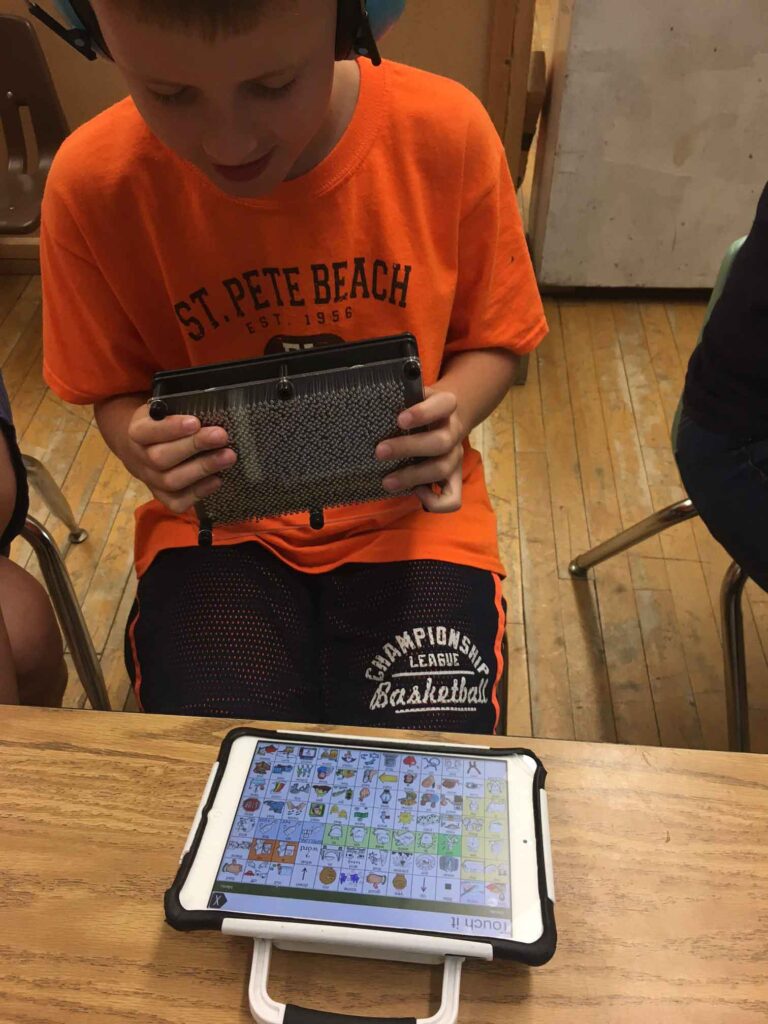
AAC includes a number of supports from picture symbols, communication boards, sign language, gestures and electronic devices.  All of these supports are used at Bridgeway Academy, where we believe every voice matters.  When faced with the decision to initiate or continue use of AAC, individuals and families often have many questions and hesitations.  ASHA highlights many common myths and research findings that can influence decisions or motivation to use AAC.

Myth 1: Introducing AAC will reduce an individual’s motivation to improve natural speech and will hinder language development (including the development of social communication skills). AAC should be introduced only after the ability to use natural speech has been completely ruled out. 

Research Findings

  • The use of AAC does not affect motivation to use natural speech and can, in fact, help improve natural speech when therapy focuses simultaneously on natural speech development and use of AAC in a multimodal approach (Millar, Light, & Schlosser, 2006; Sedey, Rosin, & Miller, 1991).
  • Intervention for minimally verbal school-age children with ASD that included use of an SGD increased spontaneous output and use of novel utterances compared with the same interventions that did not include use of an SGD (Kasari et al., 2014).
  • AAC can help decrease the frequency of challenging behaviors that may arise from frustration or communication breakdowns (Carr & Durand, 1985; Drager, Light, & McNaughton, 2010; Mirenda, 1997; Robinson & Owens, 1995).

At Bridgeway Academy nearly all clients who use AAC develop some speech and many have become completely verbal communicators!

Myth 2: Young children are not ready for AAC and will not require AAC until they reach school age.
Research Findings

  • Early implementation of AAC can aid in the development of natural speech and language (Lüke, 2014; Romski et al., 2010; Wright, Kaiser, Reikowsky, & Roberts, 2013) and can increase vocabulary for children ages 3 years and younger (Romski, Sevcik, Barton-Hulsey, & Whitmore, 2015).
  • AAC use with preschool-age children has been associated with increased use of multisymbol utterances and development of grammar (Binger & Light, 2007; L. Harris, Doyle, & Haff, 1996; see Romski et al. [2015] for a review).
  • AAC use can lead to increases in receptive vocabulary in young children (Brady, 2000; Drager et al., 2006).

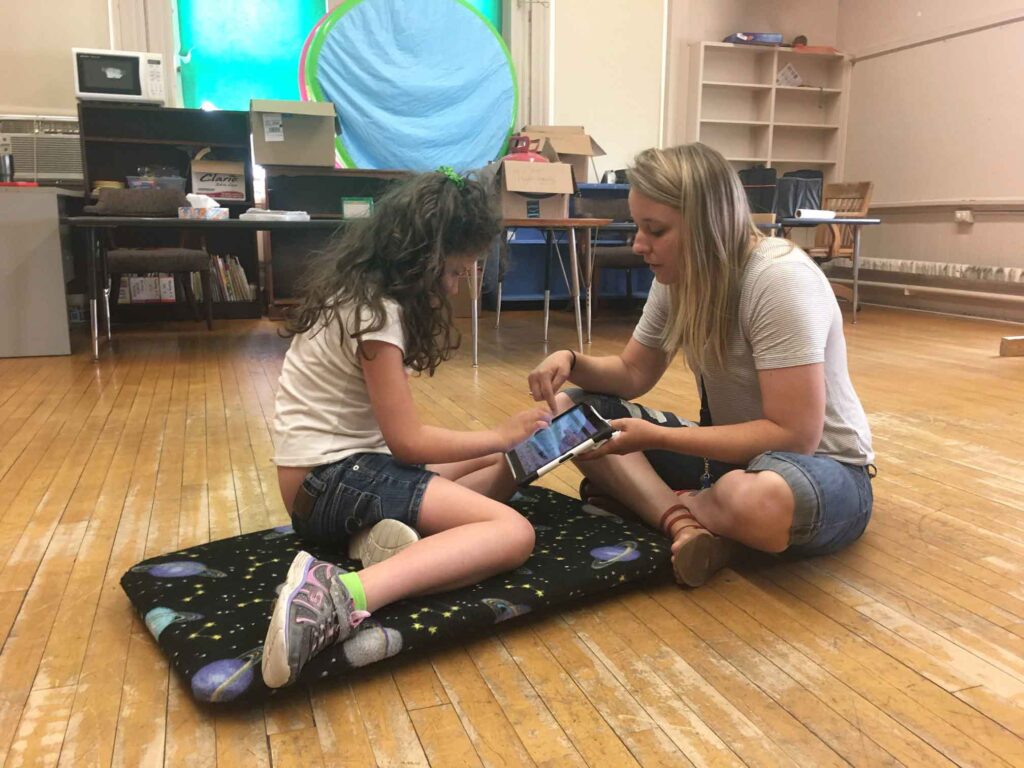
Bridgeway Academy students often get AAC devices as early as three but we have had success using the devices with children as young as 12 months.

Myth 3: Prerequisite skills such as understanding of cause and effect and showing communicative intent must be demonstrated before AAC should be considered; individuals with cognitive deficits are not able to learn to use AAC.

Research Findings

  • Measures of pre-communicative cognitive ability may be invalid for some populations, and research suggests that impaired cognition does not preclude communication (Kangas & Lloyd, 1988; Zangari & Kangas, 1997). Development of language skills can lead to functional cognitive gains (Goossens’, 1989).
  • AAC intervention for children with complex communication needs helps develop functional communication skills, promotes cognitive development, provides a foundation for literacy development, and improves social communication (Drager et al., 2010).

At Bridgeway Academy we see that the foundations of language development can be established while using AAC devices rather than waiting for these skills to be developed.

Currently, over 100 Education Center students and Therapy Center clients use high-tech speech-generating devices.  Bridgeway Academy is one of nine LAMP Centers of Excellence in the nation, with six LAMP Certified Professionals.  LAMP, or Language Acquisition through Motor Planning, is defined as “… a therapeutic approach based on neurological and motor learning principles. The goal is to give individuals who are nonverbal or have limited verbal abilities a method of independently and spontaneously expressing themselves in any setting.”

With several papers ready for publication and presentations at national conferences, Bridgeway Academy, partnering with The Ohio State University’s Autism & Child Language Learning Lab is at the forefront of research in the field of AAC. We are proud to be supporting the development in the field at the global and local levels.
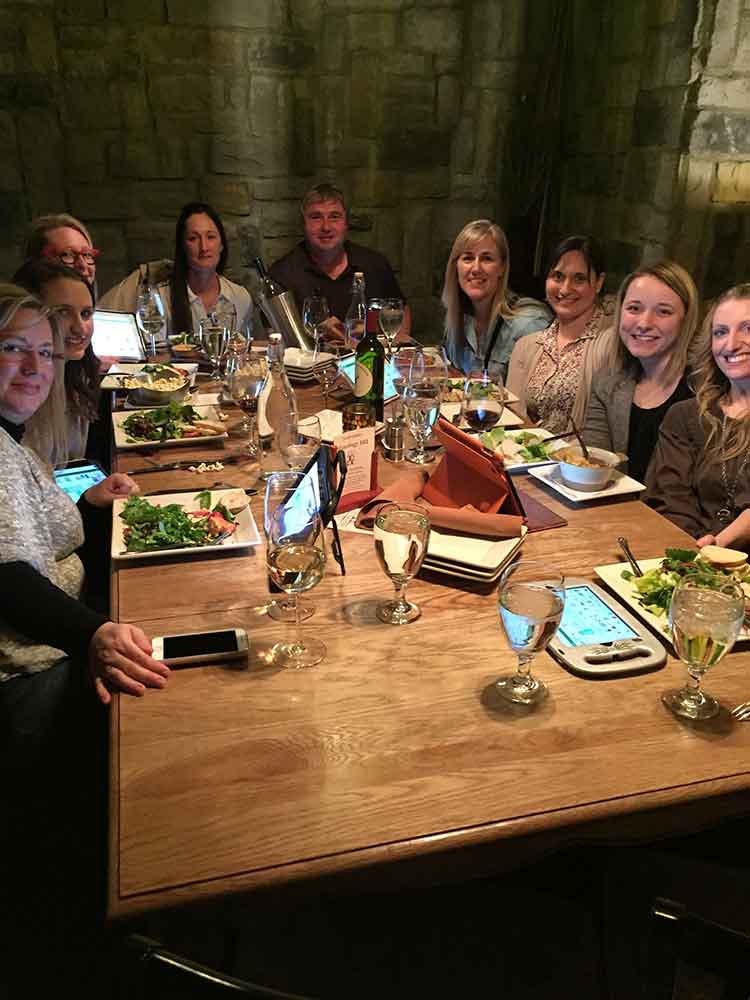
Several years ago, the speech department coined the term “Chatterbox Challenge” to represent an immersive language experience to practice using speech-generating devices to become better teachers, models, and prompters for our students and clients.  The speech therapy department will be taking the Chatterbox Challenge again this year and plan to help facilitate any other groups of teachers, parents, caregivers and professionals that would like to accept the challenge as well.  Please get in touch with your child’s Speech-Language Pathologist for more information on AAC or the Chatterbox Challenge!

Written by alex · Categorized: Uncategorized

Sep 19 2017

Did you know? Social Skills Beyond Conversation

By: Laura Gilbert, MA, CCC-SLP, Alexa Reck, MA, CCC-SLP, Jennifer Swetnam, MA, CCC-SLP and Cassie Wilhelm, MA, CCC-SLP

Social skills are a core challenge for young people with autism.  In typical development, young people often learn these skills by observing others in interactions with adults and peers. Young people with autism can benefit from direct instruction in this area. In order for students to understand and carry over their skills, we believe it is important to teach the students WHY they should care about learning them. However, unlike other skills, social skills do not have hard and fast rules. They change with each environment, conversational partner, and common goal.

There are a wide range of social skills including:

  • Joint attention/engagement
  • Social reciprocity
  • Social cognition
  • Conversation
  • Literacy
  • Executive function
  • Theory of mind
  • Body language/awareness
  • Check in with your eyes
  • Being a part of the group
  • Getting in the group, letting others in the group
  • Varied expectations
  • Non-verbal cues/communication

At Bridgeway Academy, our Speech-Language Pathologists provide services related to social skills and communication in a variety of ways. Social skills services can include individual sessions, support in community and vocational settings, and group therapy sessions during the school day and after school.

We have recently introduced two group settings to our services: 

Social Skills After School Groups
In Social Skills Group, tweens and young teens discuss and improve upon their social skills with the guidance of two Speech-Language Pathologists. Each session includes time for peer conversation, review of previous lessons, teaching on an aspect of social language and its importance, and activities that allow practice of social skills. Students help create and then use a rubric to evaluate their own social skills and measure their progress over the course of the year. Therapists involved in Social Skills groups have attended Social Thinking™ trainings (www.socialthinking.com) and employ many of their principles and materials. Objectives are established based on the needs of group members rather than following a set curriculum.

Young people who would most benefit from this group should be able to participate in a small group (4-6 people) activity with peers with minimal prompting. Social Skills groups meets weekly for 60 minutes after school hours. One group meets Tuesdays 4-5 and a separate group meets Wednesdays 3:45-4:45. If you are interested, please contact cwilhelm@bridgewayohio.org.

Yearbook Club
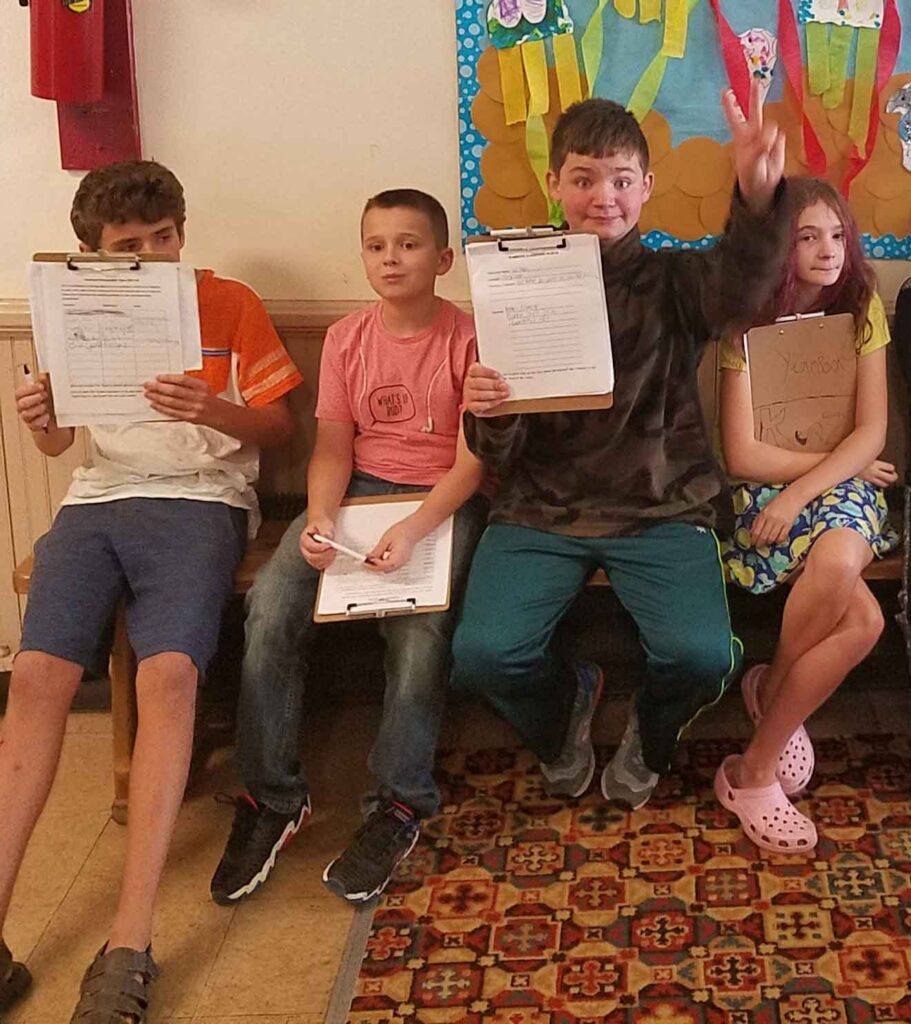
This year, we are also initiating Yearbook Club in one of our classrooms. This is giving students the opportunity to gain experience with the following skills: working on a team with a common goal, coming up with thought provoking questions for others, making eye contact and having body orientation toward communication partners while interviewing, maintaining an appropriate tone of voice, taking others’ perspectives and thinking about their point of view, focusing on others’ body language when taking photos, and other various perspective taking and social skills.

Written by alex · Categorized: Uncategorized

Sep 06 2017

The first few weeks of school have FLOWN by!

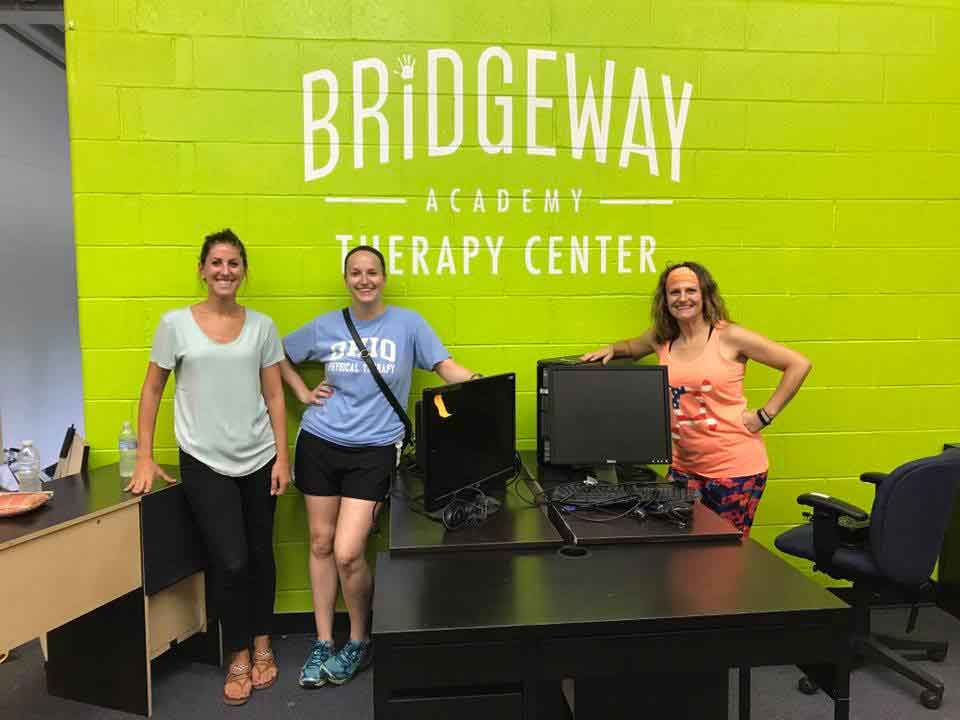
The opening of the Secondary School and Therapy Center brings many exciting changes and opportunities for the 2017-18 academic year. We look forward to sharing all of them with you in the coming months. In the meantime, we are so grateful to everyone, including our Change Champions, who helped with planning and provided positive feedback and communication during this transition. As always, our staff and volunteers put their blood, sweat and tears into preparing both the Secondary and Primary Schools to open and operate effectively on our first day of school. We couldn’t do it without them.

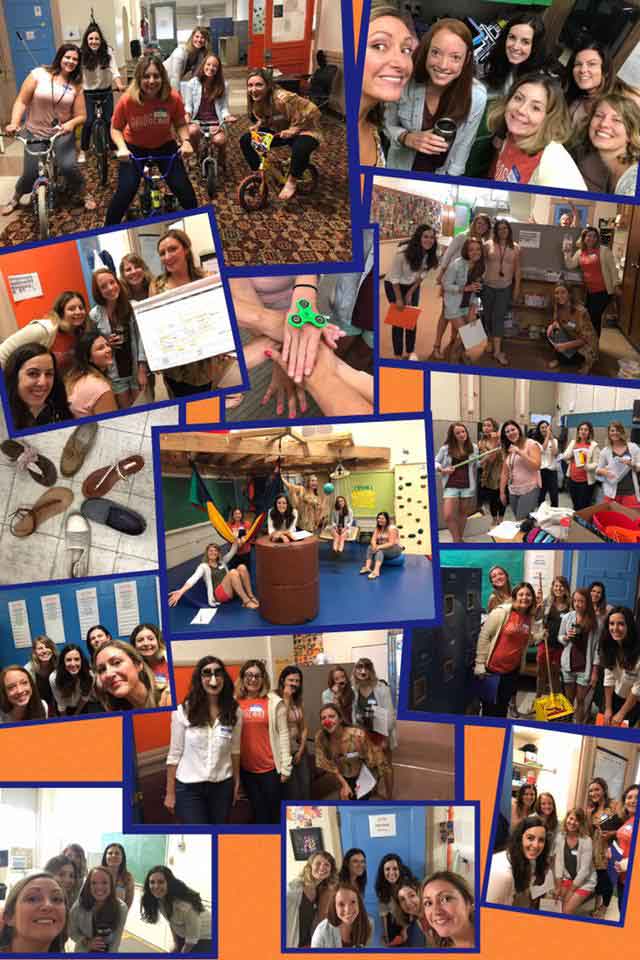
We began the academic year welcoming 24 new staff members including highly qualified teachers and therapists, a new psychologist and a new administrative assistant. Our staff participated in a great week of training and some fun team-building, including a scavenger hunt. They had the opportunity to let their silly sides through while getting to know new and returning staff and the new Secondary School space.

We are looking forward to the year ahead with our returning and new students, families and staff. We began the academic year with 175 students in preschool through 11th grade representing 28 unique school districts from 9 different counties. And, we begin the year with more than 180 staff members serving our students and families! As we look forward at the calendar, we want to remind our friends and families of some upcoming special events. We hope you will mark your calendars and join us!

Curriculum Night: September 14, 6-8 PM
During Curriculum Night, we welcome parents and adult family member ONLY. The evening is divided into two-three short sessions- one session in your child’s classroom to learn more about what to expect this year from your child’s teachers and curriculum and a session for general information in the gym with Bridgeway Academy leadership staff. We’ll give some general reminders as well as introduce a new Emergency Response system recently adopted by Bridgeway Academy. We will also offer an additional session for parents who have multiple students enrolled in Bridgeway Academy.

Picture Day: Secondary School Picture Day October 16th / Primary School Picture Day October 17th
Ryan Glaze Photography will join Bridgeway Academy again this year for school pictures. Parents and families will receive = information in late September. A classroom composite will be available for purchase this year and our brand new STUDENT YEARBOOK COMMITTEE will be producing the yearbook!

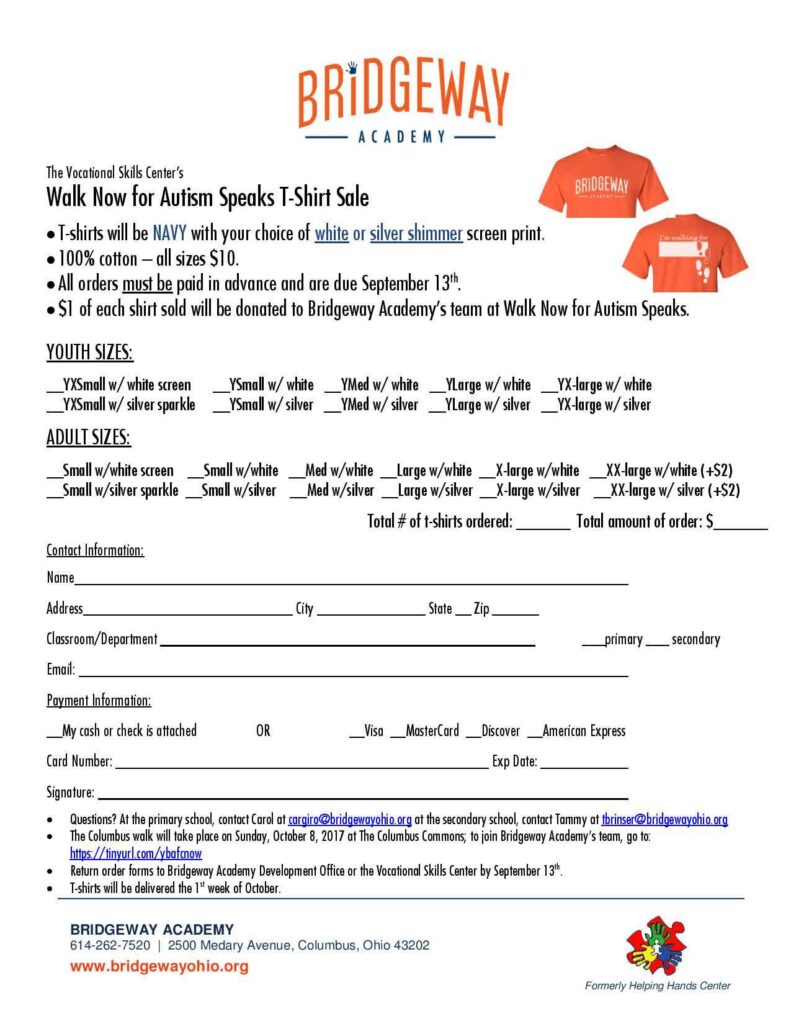
Walk Now for Autism Speaks: October 8 at the Columbus Commons
Join Bridgeway Academy’s Team and walk with us to support Autism Speaks.

http://act.autismspeaks.org/site/TR/Walk/Ohio?team_id=60955&pg=team&fr_id=3004

Bridgeway Academy’s Skills Center students will be selling team shirts the 1st two weeks of September with $1 of every shirt sold donated to Team Bridgeway’s fundraising efforts for Autism Speaks.

Practice Trick or Treat night: October 26th – 4:30-6:00 PM, Primary School and Therapy Center
Get your family and friends and grab a costume! We are excited to welcome ALL Bridgeway Academy students from both the Primary and the Secondary School and Therapy Centers, along with friends and community partners to this event! Come practice your Trick-or-Treat skills in our very own Trick-or-Treat Street where both candy and non-candy treats will be provided. In addition, we’ll have arts and crafts, a spooky and silly Haunted Speech Room, a sensory-obstacle course, a Monster Mash dance in the gymnasium and our first ever Trunk-or-Treat Street with the Secondary School Teaching Teams! You won’t want to miss this fun family event.

We look forward to seeing all of you over the course of the year. Maybe at pick-up or drop off at Walk Now for Autism Speaks; or, at our events, SPIN for Camp Bridgeway on  March 4th, or in April at Raise Your Glass to Raise Awareness. And as always, we thank you for your interest in and support of Camp Bridgeway.

Written by alex · Categorized: Uncategorized

Jul 26 2017

Bridgeway Goes to China

By: Lara Pytlik, MOT, OTR/L

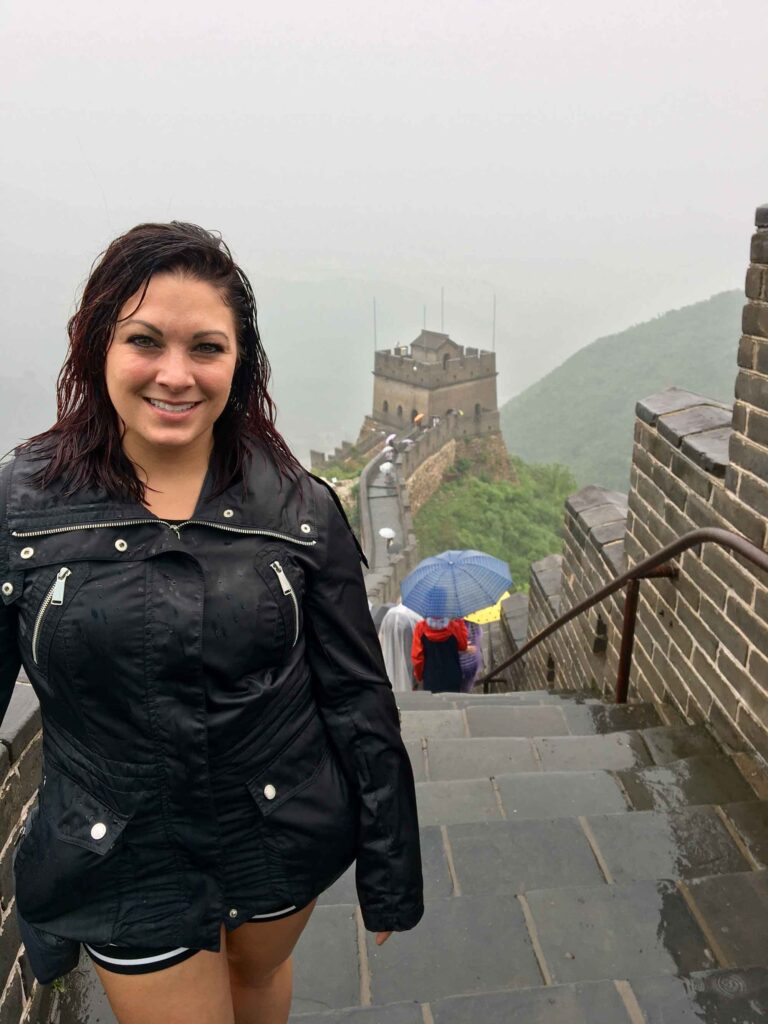
Helping children succeed and traveling. Two things I’m most passionate about. What happens when you put those together? You spend the first two weeks of July exploring Beijing and Yanjio, China along with a group of 13 people for tourism and service projects.  After a friend asked me to join her on what appeared to be an amazing adventure, I quickly answered ‘YES!’ and soon after we were touring through Beijing for a week seeing sights such as Tiennamen Square, the Forbidden City, the Great Wall of China, and navigating our way past many adventurous food options.

Our second week was spent in Yanjio, China helping friends at the Living Tree Foster Home.  Since 2002, Living Tree has served the
needs of orphaned children in China with Cerebral Palsy. This foundation ensures these children are loved, cared for, and given a happy life through meeting daily living needs, rehabilitation centers, workshops, special education schools, and intensive care rooms for the more medically fragile children. Currently 29 children live at Living Tree ranging from 2 – 19 years old.  They employ 15 full-time workers and welcome hundreds of volunteers each year.

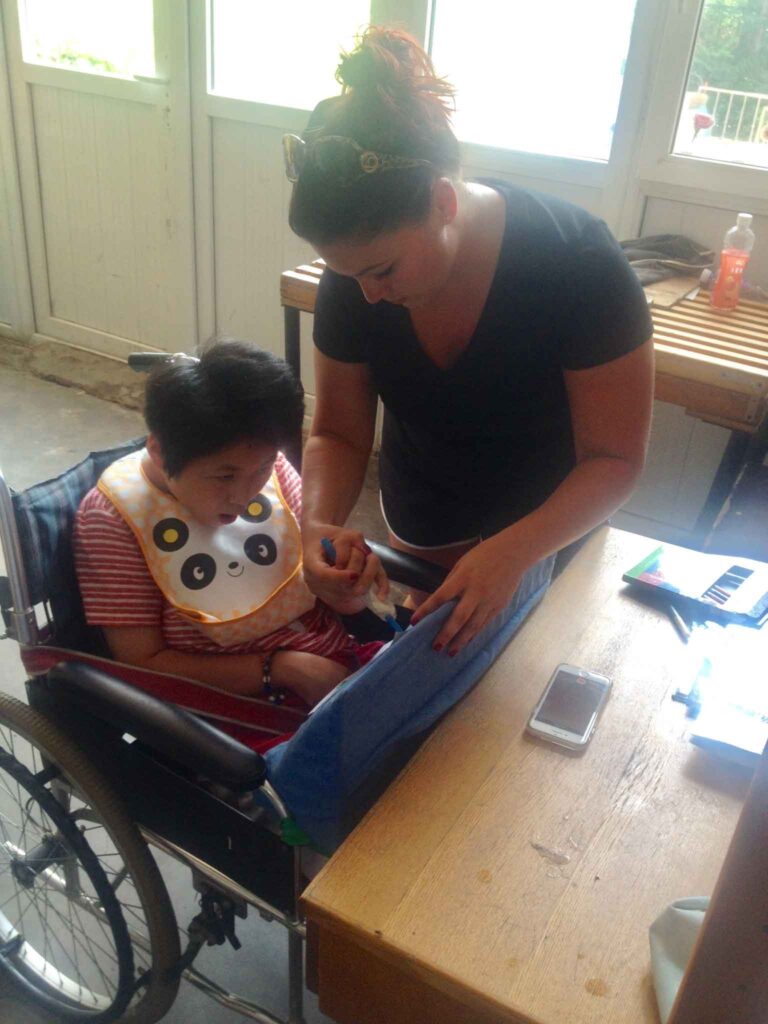
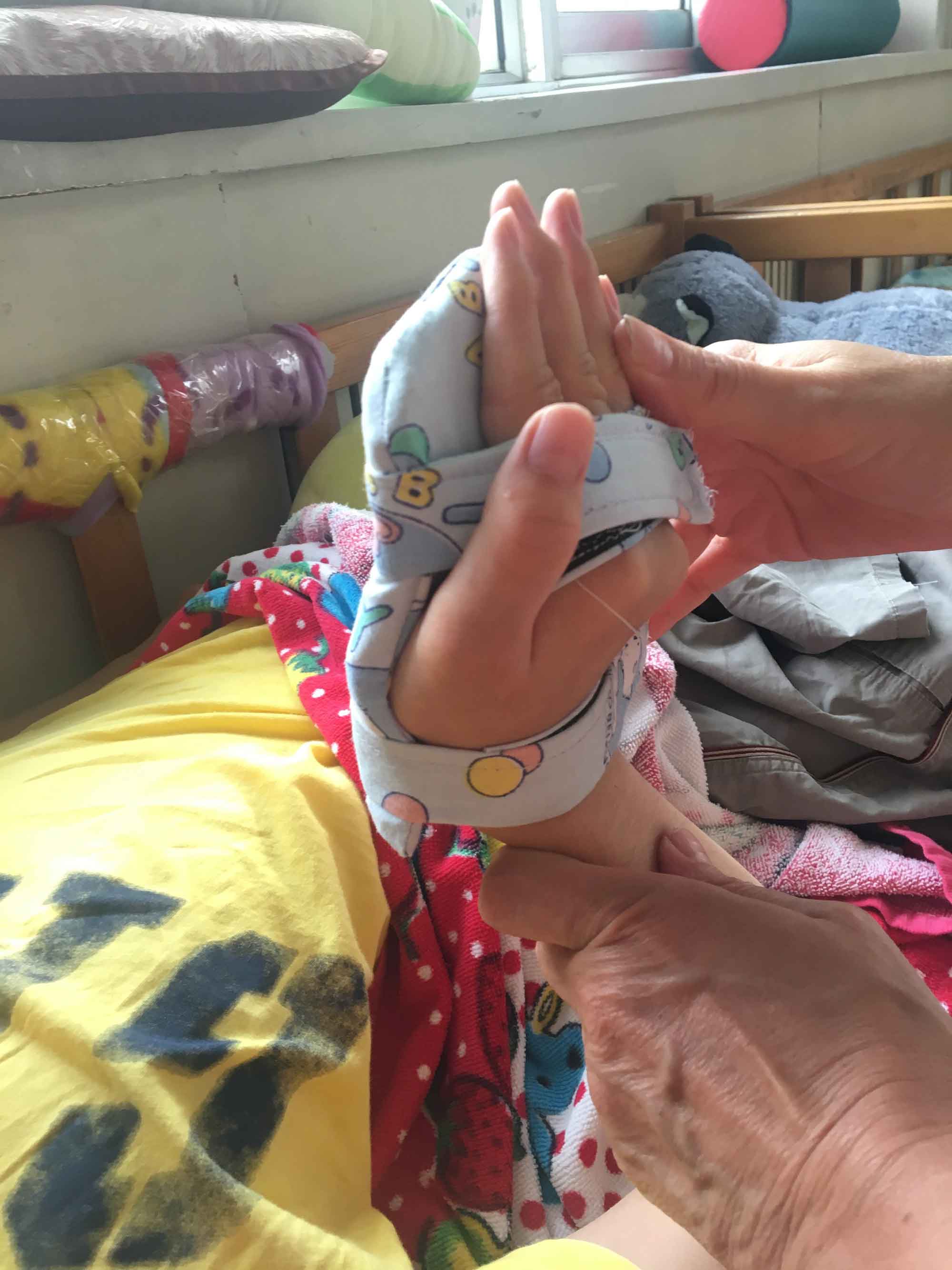
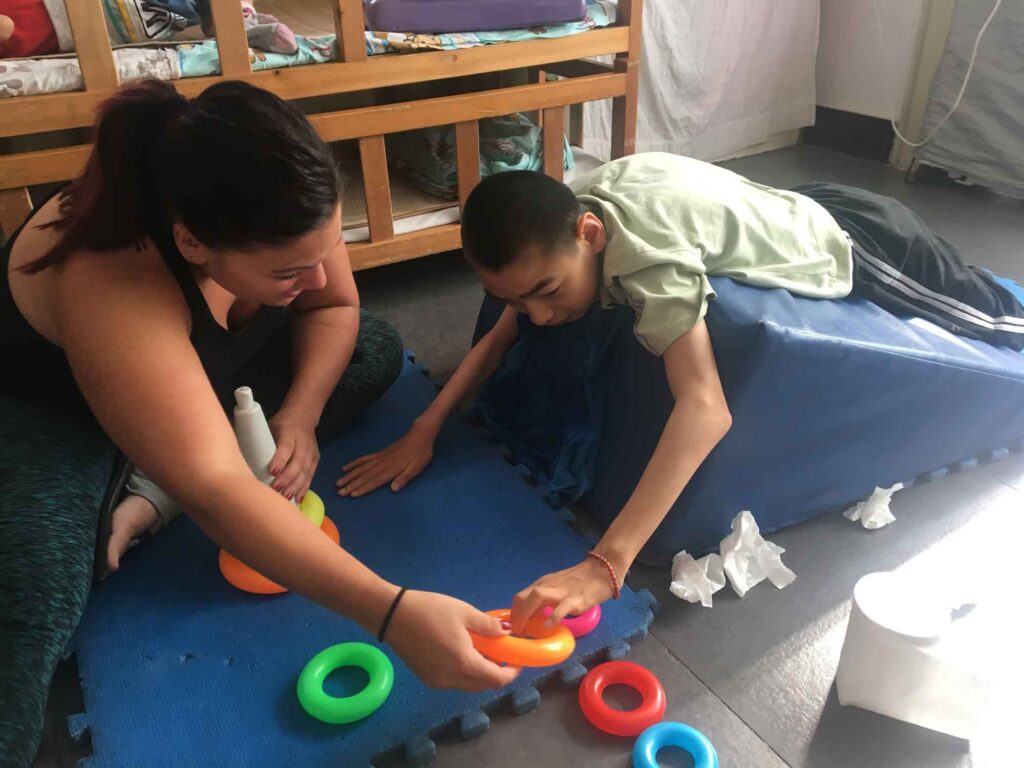
I could not wait to spend time with these children and help the orphanage complete a variety of tasks they had prepared for us, but litlle did I know how much of the ‘occupational therapist’ role I would take on during my week there. It was not long before I saw the great need this organization had – a lack of resources and a lack of financial means; but, after only minutes inside the walls of Living Tree, you know it’s a very special place and the workers are truly dedicated and loving.  They are eager to be educated on therapeutic techniques and ways to help better these children’s quality of life.  Using supplies such as pizza boxes, plastic formula lids, scraps of fabric, foam wedges and bubble wrap, I spent my week creating and educating.  I demonstrated prone prop position over a wedge to improve upper body strength and head and neck control, taught workers how to use common toys as therapeutic materials to encourage range of motion and stretching of upper extremities, created built-up utensils and writing tools for increased independence eating and coloring, fabricated hand splints to prevent contractures, and fit children into wheelchairs to promote improved seating and positioning.

This service trip was truly the experience of a lifetime. The children and workers I met will always have a special place in my heart. I returned from China more grateful and thankful for the opportunities and resources our children and students have every day. My love for occupational therapy has only strengthened and will continue to thrive through the kids of Bridgeway Academy!

Written by alex · Categorized: Uncategorized

Jun 06 2017

Bridgeway Academy’s Got Talent

Camp Bridgeway, Bridgeway Academy’s 8-week summer program, begins Tuesday, June 6th! The 2017 camp theme is “Bridgeway Academy’s Got Talent,” and will showcase the many talents and abilities of Bridgeway Academy’s 136 student campers, ranging from age 3 through 10th grade.

Weekly activities of Camp Bridgeway include music therapy groups, arts and crafts, physical fitness and outdoor play, social skills development, water play, special guests and daily academic review.  Special activities relating to the weekly mini-theme or overall camp theme will also be included and led by Bridgeway Academy’s teaching staff.

Week One – Bridgeway Scientists: campers will explore science with visits from a Metro Parks naturalist, a remote control airplane demonstration and exploring fun science experiments.

Week Two – Bridgeway Performs: campers will explore Japanese taiko drumming with Eric “the Fish” Paton and listen to the blues through a performance by Blue Spectrum.

Week Three – Bridgeway Explores: campers will explore scuba diving and farm animals.

Week Four – Bridgeway Celebrates: activities of the week will include a visit from BalletMet and a celebration of Independence Day and annual 4th of July parade.

Week Five – Bridgeway Eats: Cooper’s Hawk will visit and give campers and exclusive cooking demonstrations.

Week Six – Bridgeway Acts: campers will explore improve comedy and drama as well as enjoy a performance by Capriccio Columbus.

Week Seven – Bridgeway Plays: sports are the focus of this week and will include a basketball exhibition and a mobile gym.

Week Eight – Bridgeway Rocks: camp will come to a close with a variety of closing activities including camp sing-a-long!

At Bridgeway Academy, summer camp is about recreation, and we provide students with important physical and social opportunities. The ability to get outside, to run, play and interact with friends is important for children with or without disabilities. Camp Bridgeway is effective because the mission and goals of camp are the same as during the academic year – to help each child reach his or her full potential by meeting this or her educational and therapeutic needs.

Written by alex · Categorized: Uncategorized

  • « Go to Previous Page
  • Page 1
  • Interim pages omitted …
  • Page 3
  • Page 4
  • Page 5
  • Page 6
  • Page 7
  • Interim pages omitted …
  • Page 10
  • Go to Next Page »

Bridgeway Academy
1350 Alum Creek Drive
Columbus, OH 43209
614.262.7520

Privacy Policy

Equal Opportunity Employer City of Columbus Franklin County Board of Commissioners

Donate Now
Facebook Link Instagram Link Twitter Link Youtube Link LinkedIn Link
The Yass Prize